

Telephone Hill Redevelopment
Latest Updates
Summer 2025: CBJ staff has begun site development and design work for the project.
5/5/2025: The CBJ Assembly appropriated $5.5M for site preparation work on Telephone Hill to begin in late 2025 and approved distribution of eviction notices to current tenants. The Assembly decided against appropriating an additional $3.5M to reconstruct roads and utilities as this would be specific to the future needs of the development. This cost may be incurred by the future developer. (View Meeting Recording and Meeting Materials)
Dec 2024 – Feb 2025: CBJ advertises a Request for Information (RFI) for development feasibility of Telephone Hill. Feedback from prospective developers indicated the need for further CBJ investment in the project.
8/5/2024: The Juneau Assembly directs CBJ Staff to develop a Request for Information (RFI) to solicit additional information from potential developers to determine necessary financial assistance for future development.
Project Summary
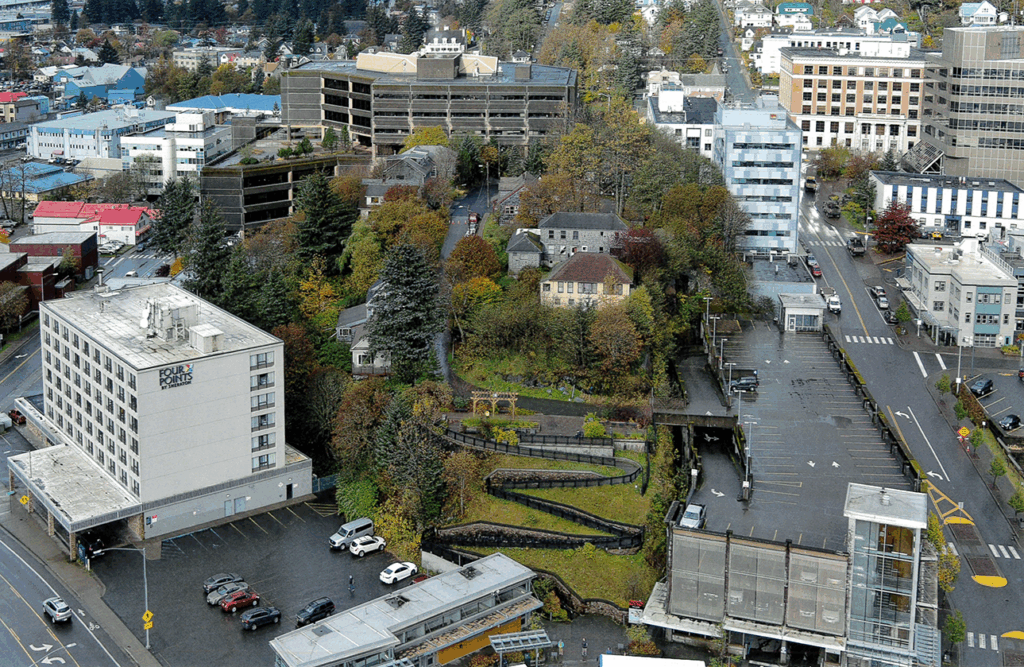
The proposed Telephone Hill Redevelopment Project will construct up to 155 housing units in downtown Juneau, with over 30 units subsidized by the City and Borough of Juneau (CBJ) to be offered at a price affordable to those making 80% Area Median Income. Telephone Hill currently houses 13 residential rental units and is located between Willoughby Avenue, Main Street, Egan Drive, and the Alaska State Office Building.
Telephone Hill was transferred from state ownership to CBJ in 2022, after the State of Alaska determined it to be in excess to the States’ needs and better used to foster economic redevelopment in Juneau. However, CBJ found that the existing structures on Telephone Hill did not meet current building safety requirements, and would require ongoing taxpayer funding to bring to code.
In 2017, the area was previously identified as downtown Juneau’s only optimal development location, although not under CBJ ownership at the time. Upon transfer of ownership, CBJ put forth the development of high-density multi-unit residential housing on Telephone Hill to address Juneau’s need for increased housing options. In 2022, Juneau voters approved $2M for this redevelopment through the 1% sales tax proposition.
In 2024, the CBJ gathered additional public input, proposals for redevelopment from qualified consultants, and data from site assessments and preliminary engineering to create a development proposal in the Telephone Hill Place Guide. Site preparation, including hazardous material disposal, excavation, and trenching for new utilities is set to begin in December 2025 with the goal of construction in 2027.
Why is CBJ moving forward with evictions and building demolition without a developer in place?
Housing has long been a top priority for CBJ and this project has the potential to seriously move the needle on housing availability and affordability in Juneau.
During the redevelopment study, initial developer interviews were conducted by Leland Consulting Group in order to gauge interest from potential development partners. While many developers showed interest in the project, the high cost of development in Juneau meant developers would need CBJ assistance to provide affordable units. Developers are also hesitant to move forward while properties are occupied, as that may lead project to stall. This construction feasibility gap is well-documented in Juneau (Northwest Douglas Subarea Study Housing Needs and Residential Financial Feasibility Findings).
The Assembly acknowledges that investment will be required to meaningfully increase housing to address Juneau’s ongoing housing crisis. While some risk is unavoidable, Telephone Hill redevelopment been carefully analyzed through the By proceeding with demolition and site development, CBJ will provide ready-to-build land to maximize developer interest and competition while also reducing design and disposal costs.
CBJ is moving forward with developer outreach with the goal of selecting a development partner in early 2026.
What is the number and condition of the existing structures Telephone Hill?
There are seven structures with 13 housing units on Telephone Hill. Per the Existing Structures Conditions Report, the condition of the structures range from “fair for [their] age” to significantly deteriorated and even hazardous. While the inspection did not exhaustively test for mold or hazardous materials, both are anticipated upon future testing given the age of the structures. Generally, the buildings also lack the structural measures required to provide an adequate level of safety (gravity/snow loading, lateral/seismic systems, etc.,) for their occupants.
Bringing these buildings up to code for safety and habitability would be a significant cost, and an inappropriate use of public funds.
What is the plan after demo? How long before construction might take place?
Following demolition, work will begin to prepare the site for future development. This work will include grading, establishing buildable lots with utilities, and re-subdividing the area. Site preparation work is expected to occur in 2026 with the goal of being complete and ready for building construction in 2027. CBJ is working to secure a development partner so that they can be involved in the site preparation and subdivision process.
What is the cost of the site development work and what does it include?
At the May 5, 2025 Assembly Committee of the Whole meeting, the Juneau Assembly approved $5.5 Million to fund demolition and site preparation work. Approved work includes demolition of existing buildings, disposal of hazardous materials, grading and rock excavation, and trenching for new utilities. An extensive environmental assessment of the site was performed early on in the process.
CBJ acknowledges that developer incentives and subsidies are a critical component of meaningfully increasing housing stock utilizing CBJ property. The $5.5M in site prep is intended to substantially address this construction feasibility gap and would be necessary for substantial housing development on any of CBJ’s developable properties.
Why is CBJ focusing on Telephone Hill for housing? What about other CBJ-owned property?
The Assembly has provided clear direction to facilitate the disposal (sale, etc.) of CBJ property for the purpose of housing. This work includes studying utilities, access, wetlands, topography, zoning and subdivisions of all CBJ property. Telephone Hill is the largest undeveloped, CBJ-owned parcel in the downtown area.
While CBJ is actively working to prepare other CBJ properties to be development-ready for future housing, Telephone Hill is unique in that it is already properly zoned, has basic utilities, direct road access and is large enough to accommodate multiple buildings.
What about the CBJ property at 450 Whittier?
This property is much smaller than Telephone Hill. The developable space is less than a quarter of that available on Telephone Hill (0.34 acres vs. 1.4 acres), however, it could be used for mixed use, office space or senior housing or other uses to aligned with the continued growth of the Aak’w Village District. This property has similar zoning to Telephone Hill and could be a great location for development but on a smaller scale.
Telephone Hill, 2nd & Franklin and 450 Whittier are all CBJ owned downtown properties and are at different stages of evaluation and preparation for redevelopment or disposal. As the largest parcel by far, Telephone Hill has the greatest opportunity to move needle on meeting Juneau’s housing needs.
What is the funding source of the $5.5M appropriated for Telephone Hill site work?
The funds appropriated for this project came from a combination of the voter approved 1% sales tax ($2M for Telephone Hill was approved by the voters in 2022) and the Lands Special Revenue fund that is comprised of funds collected from the sale and development of CBJ property specifically designated to develop and manage City land. Only $1M was appropriated from the CBJ general fund.
How much buildable land will be available after demolition?
The total redeveloped area, per the conceptual plan shown in the Telephone Hill Place Guide, is 1.4 acres. This area is sufficiently sized to allow for the four parcels and improved roadway as shown in the Place Guide.
The Telephone Hill park, switchback trail, and parking garage will remain unchanged.
How many housing units can/will be developed? What type and affordability level?
Four new buildings could provide up to 155 housing units in total. While larger, denser buildings are possible, density was determined through public outreach and understanding the preferences of the community.
The Assembly did a comprehensive Market Analysis, Feasibility Analysis, and Development Strategy for Telephone Hill that determined that a) there is absolutely a need for workforce and affordable housing and b) a developer will need the municipality to be involved through project development, tax abatement, low interest loans. The study goes into detail on the cost of construction for such a development and what financing gap would be needed to incentivize developers to develop affordable housing.
These units will be subsidized by CBJ and represent roughly double the affordable housing opportunity and capacity of the existing structures. The remaining 80% of units will be priced by the developer as necessary to balance project financial pro forma.
How does the Telephone Hill redevelopment connect to United States Coast Guard (USCG) housing needs with the new ice breaker?
Based the Northwest Douglas Subarea Study Housing Needs and Residential Financial Feasibility Findings for the City and Borough of Juneau, more than 600 units at all affordability levels will be required to cover the existing and forecasted gap in Juneau’s housing stock, including that associated with the approximately 200 relocating USCG servicemembers and their families.
Is the developable land structurally sound enough to support multistory buildings? How do you know?
Yes, the area bedrock is very strong and previous geotechnical investigations for the Downtown Parking Garage have determined the slopes are stable. Geotechnical engineers from RESPEC visited Telephone Hill in August 2025 and did not report any evidence of instability or compromised soils that would jeopardize future development. RESPEC also relayed that they did not observe any stability issues that would bring the project’s feasibility into question.
A detailed geotechnical report will be prepared to inform design of any necessary retaining and support structures so engineers can ensure the weight of new structures are safely transferred to the strong, bedrock base. It is usual and typical for this detailed geotechnical work to take place post-demolition. Conducting it prior to demolition could increase costs and delay the project.
I’ve heard there is a tunnel under Telephone Hill?
The Second Street Tunnel runs between Main Street and Willoughby Avenue. Survey data shows the top of the tunnel is approximately 12-15 feet below the finish grade on top of the hill. At this depth, engineers do not believe the tunnel presents a risk to the stability of the ground above.
That said, building parcels are set on both sides of the tunnel separated by a 30’ easement, so no new buildings are planned to be constructed directly over the top of the tunnel.
Why isn’t CBJ following Section 106 protocols? Doesn’t that mean we won’t be eligible for future federal funding?
Section 106 reviews are only triggered if there is a federal agency, federal jurisdiction, or federal money involved with a project. None of those are applicable at this time with Telephone Hill, nor is any future federal agency involvement expected. CBJ is collaborating with the USCG to secure housing units for the incoming servicemembers and support staff across Juneau. The intention is not for the USCG to purchase or be the developing entity for Telephone Hill. In short, a Section 106 cannot be pursued because CBJ is not in a position to even get the process started.
This alone does not disqualify a developer from applying for federal funding and they would need to complete a separate Section 106 review under that particular federal funding agency after their building design reaches a certain point.
CBJ has also done a comprehensive Cultural Desktop Assessment and Site and Structures Survey that document the cultural and historical significance of the buildings and place.
Will it just be housing? What about green space and parking?
While housing is the primary focus, considerations have been made for other features to be included in redevelopment. No additional parking is required to be added as part of redevelopment due to Telephone Hill being within the Downtown Zero-Parking zone. However, it is possible for developers to include additional parking in future structural designs.
The existing Telephone Hill park, switchback trail, and parking garage will remain unchanged.
Who is asking for this? How did we get here?
Just as the community has long been struggling with an ongoing housing shortage, With plans never materializing for the complex, the land was transferred to CBJ in 2022 to pursue economic redevelopment.
Aligning with Assembly goals of providing more housing in Juneau, CBJ began a redevelopment study in 2022 with the intent of determining a preferred development option. Through public outreach and market analysis, CBJ concluded that high-density, residential development is a feasible option that would provide relief to Juneau’s tight housing market.
The Assembly and CBJ staff are and will continue to be fiscally prudent with City funds, while meeting the larger goal of providing affordable housing and units that our youth and working families can live in. The return on our investment is the existence of our community as a thriving place where all generations can live, work, and play.
Was there a public vote on redevelopment of this land?
Yes. $2 million in funding for the redevelopment of Telephone Hill was included in the 1% sales tax proposition approved by voters in the 2022 Municipal Election (https://juneau.org/onepercent).
A public vote on the nature of the redevelopment is not required, however, as the project moved forward, a robust public process took place to ensure that CBJ was acting in a manner that meets public purpose and the needs of the city and borough as a whole.
Why is this area being redeveloped vs other areas of downtown Juneau with derelict buildings or no structures?
CBJ cannot mandate downtown property-owners to redevelop their private property.
In 2006 CBJ completed a buildable lands study that evaluated all CBJ properties for slope, wetlands, hazard zones, access and utilities in order to identify land for development. Of the 14 potential sites studied, there were zero located in downtown Juneau. Telephone Hill was not under city ownership at the time of the study but was identified as an optimal development location due to its size, road access, and mixed-use zoning.
Now that Telephone Hill is under CBJ ownership, it stands as the largest city-owned land parcel in downtown Juneau feasible for redevelopment.
Will the City continue to manage the land after it’s developed by contractors?
It is unlikely that the City will continue to own or manage this property after it is developed. One of the objectives of developing Telephone Hill is to facilitate the transfer of this property into private ownership.
Study Area & Current Use
The project study area sits on roughly 4.2 acres of land in Downtown Juneau. Telephone hill is confined by Willoughby Avenue to the North, Main Street to the South, Egan Drive to the West and the Alaska State Office Building to the East. Today, the area includes 13 residential rental units, surface and structured parking, the Downtown Transit Center, and a public park and road.
Access challenges make Telephone Hill a relatively low-traffic area compared to the rest of Downtown Juneau. Due to the extreme topography, there are limited options for traveling to or through Telephone Hill which acts as a natural barrier between the Downtown and Aak’w Kwaan Village Districts. Popular access features include W. 3rd Street for vehicular traffic and elevators at the DTC Parking Garage and State Office Building for pedestrians.
Historic Preservation
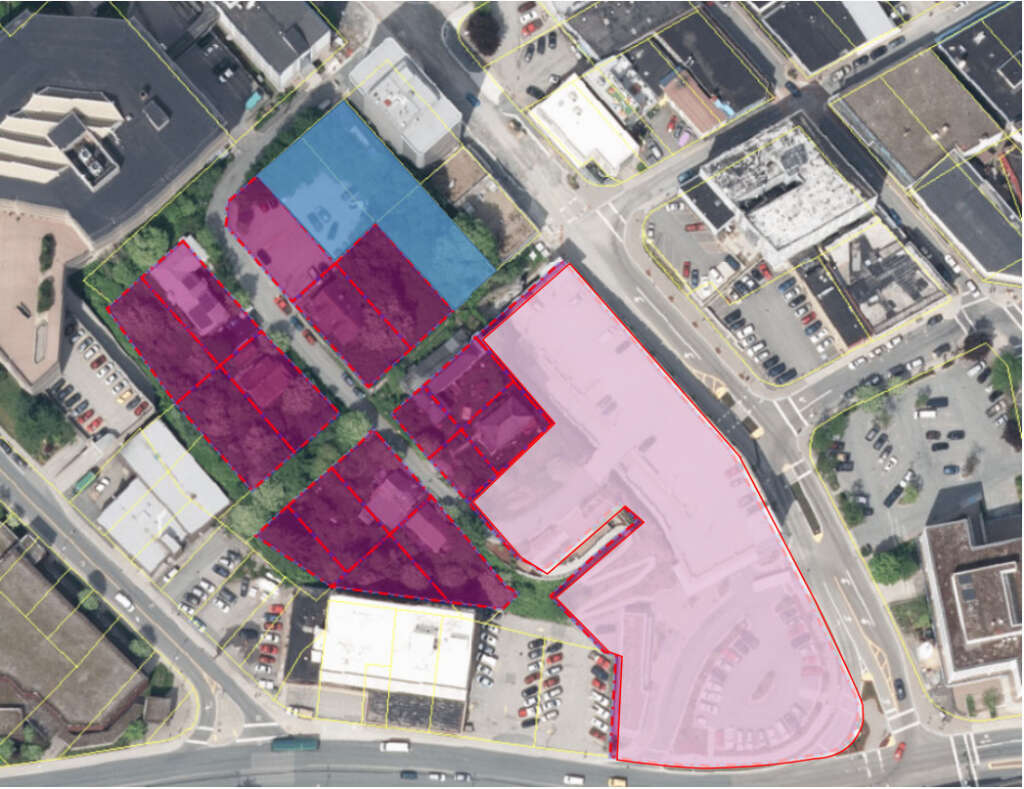
The City and Borough of Juneau, First Forty Feet, and MRV Architects have been working to address the historic preservation components of the Telephone Hill redevelopment area as part of the development of a master plan and high-level civil engineering concepts.
The project location was formerly owned by the State of Alaska (SOA) but was classified as surplus property and subsequently transferred to the CBJ for economic redevelopment during the 2022 legislative session.
In its current configuration, the project is not a Federal Undertaking subject to Section 106 of the National Historic Preservation Act (NHPA) or the National Environmental Policy Act (NEPA). The Project does not involve State of Alaska owned or controlled lands and is not subject to the provisions of the Alaska Historic Preservation Act. Despite the lack of a federal or state nexus that would trigger an assessment of the Project’s potential to impact historic properties and in response to feedback received through community outreach, the CBJ has chosen to complete a cultural resource desktop assessment and update a historic site and structures survey for the known sites (structures) listed on the Alaska Heritage Resources Survey (AHRS), located within the Telephone Hill redevelopment area.
CBJ contracted with First Forty Feet (FFF) who hired two firms to provide historic preservation expertise and to complete these efforts:
- FFF contracted Northern Land Use Research Alaska, LLC (NLURA) to complete a cultural resource desktop assessment. Beginning in August 2023, NLURA completed a review of previous reports, surveys, and consultation documents to identify cultural resources and historic properties within the Project Study Area.
- FFF contracted with MRV Architects to update the Telephone Hill Historic Site and Structures Survey of 1984. Beginning in August 2023, the project team looked at the history of Telephone Hill and surveyed individual structures to update the 1984 report.
Timeline & Status
Summer 2025: CBJ staff has begun site development and design work for the project.
5/5/2025: The CBJ Assembly appropriated $5.5M for site preparation work on Telephone Hill to begin in late 2025 and approved distribution of eviction notices to current tenants. The Assembly decided against appropriating an additional $3.5M to reconstruct roads and utilities as this would be specific to the future needs of the development. This cost may be incurred by the future developer. (View Meeting Recording and Meeting Materials)
Dec 2024 – Feb 2025: CBJ advertises a Request for Information (RFI) for development feasibility of Telephone Hill. Feedback from prospective developers indicated the need for further CBJ investment in the project.
8/5/2024: The Juneau Assembly directs CBJ Staff to develop a Request for Information (RFI) to solicit additional information from potential developers to determine necessary financial assistance for future development.
6/3/2024: A total project cost estimate of $52 million is presented to the Juneau Assembly. CBJ Staff requests the Assembly consider and provide feedback on possible incentives to offer new development in order to provide affordable housing.
4/15/2024: CBJ Staff provides the Juneau Assembly with an updated cost estimate for site preparation work necessary to facilitate new development of $5 million. This estimate includes upgrading underground utilities, reconstruction of Dixon Street, demolition and establishing buildable parcels. Juneau Assembly motions to extend the downtown zero-parking zone to include Telephone Hill and not require development provide additional parking.
2/22/2024: Members of the project team attended a special Historic Resource Advisory Committee (HRAC) meeting to answer questions regarding the project and recent Assembly direction.
2/12/2024: CBJ Staff gives update to Juneau Assembly Committee as a Whole. The Juneau Assembly motions for continued design refinement of high-density housing development.
2/6/2024: NLURA completes a Cultural Resource Desktop Review of the Telephone Hill site and buildings.
12/08/2023: Telephone Hill Redevelopment survey is made available through 01/09/2024. (survey link: https://www.surveymonkey.com/r/TelephoneHillRedevelopment)
11/29/2023: RESPEC completes a structural condition assessment report of the existing homes on Telephone Hill.
10/11/2023: Project team hosts a public engagement session to present design concepts for redevelopment.
8/26/2023: A project update is given at the Juneau Assembly Committee as a Whole.
7/26/2023: Project team hosts the first public open house to introduce the project and begin collecting public input.
6/14/2023: First Forty Feet’s contract is signed and project kick-off work begins.
3/10/2023: CBJ elects First Forty Feet out of Portland, OR to be the prime consultant in the study.
12/21/2022: CBJ begins soliciting for consultants to assist in redevelopment study
Community Outreach
Public feedback is important to the CBJ and the project team in identifying community values and desired outcomes for potential redevelopment in the project study area.
The first public open house for the project was held on July 26, 2023 and allowed the project team to introduce the project and solicited input from about 60 Juneau residents. A questionnaire was presented and gave the audience the opportunity to submit responses. Those responses help show the public perception of the current Telephone Hill and identify community values that will assist in determining the future of the area. The results can be found in the “Relevant Documents” tab.
An engagement session was held on October 11, 2023 to present the initial design concepts for redevelopment. These concepts showed a varying level of development including low to high density housing as well as mixed infill that would preserve the existing houses. The intent of these concepts is to visualize redevelopment and allow the community to comment on each concept in order to show their ideal development scenario.
A public online survey was open from December 12, 2023 through January 9, 2024. This survey asked for public opinion on the design concepts and how Telephone Hill can best fulfill the needs of the community. The final results of this survey can be found in the “Relevant Documents” tab. Members of the public are encouraged to comment on future development on Telephone Hill by reviewing previous design concepts and project documents.
Additional public comment can be sent to [email protected]
Relevant Documents
RFI 25-224 Telephone Hill Development Feasibility
Telephone Hill Redevelopment Study
Community Engagement Feedback Form – Project Initiation
Community Engagement Feedback Form – Design Concepts
Telephone Hill Existing Structures Condition Report
Cultural Resource Desktop Assessment
MRV Report – Updated Site & Structures Survey
Second Public Meeting Concept Comments
Telephone Hill Online Survey Final Results
Market Analysis, Feasibility Analysis, and Development Strategy
Contact Us
To comment, provide input, or for general project inquiries, please email [email protected]