

Municipal Elections – Frequently Asked Questions
For all municipal voting information, call (907) 586-5278 option 4, email [email protected], or go to the CBJ Elections website.
Election Basics
CBJ holds an election every year on the first Tuesday in October. Ballots are mailed to all registered voters 18 days prior to the election. In 2026, ballots will be mailed out on September 18 and must be returned by 8:00pm on Tuesday, October 6 or postmarked by Tuesday, October 6.
- Ballots mailed: September 18
- Vote Centers open: September 21
- Election Day: October 6
- Cure deadline: 9:00am October 20
- Certification: October 20
To vote in this election you must be a US citizen, 18 years of age, a resident of the City and Borough of Juneau for at least 30 days before the election, and registered to vote on or before the registration deadline (30 days before the election). You can register to vote here or check your registration here.
About Vote by Mail
Vote By Mail is a system where ballots are mailed to eligible Juneau voters at their mailing address and voters can make decisions from the convenience of their home. Voters can return their mailed ballots during the 2-week period through Election Day:
- By placing it in a secure drop box
- By mailing it through the U.S. Postal Service using first class postage
In 2007, the Assembly changed the Election Code to allow for elections to be conducted by mail.
In 2019-2020, the State of Alaska notified local jurisdictions that they would no longer be sharing the precinct polling place election equipment with municipalities so all Alaskan municipalities were required to find alternative solutions for conducting local elections.
In 2020, CBJ partnered with the Municipality of Anchorage to conduct the regular election by mail due to the pandemic. Due to its success and increased voter turnout, CBJ decided to conduct the 2021 Regular Municipal Election in the same way.
In 2021, the CBJ Assembly appropriated funds for the creation of the new CBJ Ballot Processing Center so that all CBJ election ballot processing could be conducted in Juneau.
In 2023, the Assembly directed staff to make all the necessary code changes to make by mail voting the default method for conducting CBJ elections. On May 17, 2023 the CBJ Assembly adopted Ordinance 2023-24 An Ordinance Amending The Elections Code Relating to Elections Procedures, which directs the Election Official to conduct all elections by mail, unless otherwise directed by the Assembly.
CBJ elections are governed by Alaska State law, CBJ Charter, CBJ Code, and Election Policies and Procedures, in that order. All election policies and procedures are published on our website at https://juneau.org/clerk/elections and cannot be changed within 40 days of an election.
Returning Your Ballot
There are five secure ballot drop boxes placed around town. They are available until 8:00pm on election night. They are located at:
Alaska Electric Light and Power Company (AEL&P)
5601 Tonsgard Ct, Lemon Creek
City Hall – Corner near Marine Way and Shattuck Way
155 Heritage Street, Downtown
Douglas Public Library
1016 3rd Street, Douglas
Mendenhall Valley Public Library
3025 Dimond Park, Valley
Statter Harbor BOAT Launch Parking
(not the Harbor Office parking lot)
11801 Glacier Highway, Auke Bay
Ballot drop boxes are emptied once per day and twice on Election Day by election workers working in teams of two. Ballots collected from the drop boxes are deposited into special bags which are locked with uniquely numbered security seals. The secure bags are transported to the CBJ Ballot Processing Center just off of Thane Road. Ballot bag handling is tracked at all times with documentation known as a chain of custody.
Ballots can be returned free of charge at any CBJ ballot drop box, available 24 hours a day, 7 days a week until 8:00 p.m. on Election Night.
If you choose to return your ballot by mail through the United States Postal Service, first-class postage is required. Voters are encouraged to take their ballot to a USPS counter and request a hand postmark.
If you return your ballot through the United States Postal Service, it must be postmarked on or before Election Day and received before the Canvass Review Board certifies the election in order to be counted.
Important: Postmarks are typically applied during USPS processing and may not reflect the exact date your ballot is dropped off or picked up.
If you are mailing your ballot close to Election Day, take it to a USPS retail counter and request a hand (manual) postmark to ensure your mailing date is clearly recorded.
Voting Options
Yes. You may vote in person at a CBJ Vote Center, listed below. State of Alaska precinct polling locations are not used for the CBJ election.
City Hall Assembly Chambers
155 Heritage Way, Downtown
Early voting starting Monday, September 21:
Open Monday through Friday, 8:00 am – 4:30 pm
Open Election Day, Tuesday October 6, 7:00 am – 8:00 pm
Mendenhall Valley Public Library
3025 Dimond Loop, Mendenhall Valley
Early voting starting Monday, September 21:
Open Monday through Thursday, 10:00 am – 6:00 pm
Open Fridays and Saturdays, 12:00 pm – 5:00 pm
Open Election Day, Tuesday October 6, 7:00 am – 8:00 pm
If you are unable to vote the ballot mailed to you or go in-person to a Vote Center, you can request to receive your ballot by an alternate method. Both methods require you to fill out an application.
Paper ballot mailed to a temporary address
- Request deadline: September 29
- Application available here
- Returned ballot must be postmarked by October 6 and received by October 19
Electronic ballot (email, fax, or secure online portal)
- Request deadline: 5:00 p.m., October 5
- Application available here
- Ballots must be returned by 8:00 p.m., October 6
Ballot Assistance
You may choose a person to assist you in marking your ballot if you need help. Assistance provided at Vote Centers or through official ballot assistance processes are subject to restrictions. In those contexts, an assistant may not be a candidate, the registered sponsor of a ballot initiative, your employer or an agent of your employer, or an officer or agent of your union.
If you are unable to sign the ballot envelope, you must make a mark or an “X” in the signature space, and a witness must sign the envelope.
Accessible Voting Options
Alternatively, there are accessible voting tablets available at both Vote Centers which have the following features:
- Large print ballots
- Audio ballots
- Touchscreen interface
- Tactile interface
- Sip-and-puff interface
Special Needs Voting
If you do not receive a ballot in the mail and are unable to vote in person due to age, illness, or disability, a personal representative may pick up and deliver a ballot for you (called “Special Needs Voting”).
Your personal representative may assist you with voting and ballot return; however, they must meet eligibility requirements under Alaska law, including that they may not be a candidate, registered ballot initiative sponsor, employer or employer’s agent, or union officer or agent.
Ballot Issues
If you make a mistake on your ballot, draw a line through the mistake and write “no” next to it. Then fill in the oval beside what you want to count.
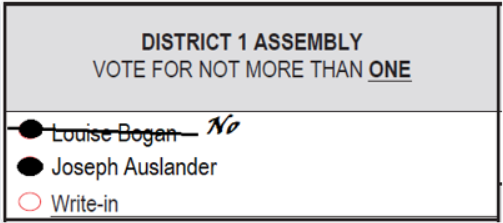
Alternatively, if your dog eats your ballot (it happened!), you can go vote in person at a Vote Center.
Signature Review and Cure Process
After your ballot is received, it goes through a signature and voter identification review process in accordance with CBJ Elections Code 29.07.150. If the signature or identifying information on your ballot envelope is missing or does not match the records on file with CBJ Elections or the State of Alaska Division of Elections, you will receive a Cure Letter.
The Cure Letter will explain the specific issue and identify the steps needed to correct it so your ballot can be counted. There are several possible reasons a Cure Letter may be issued, and the specific reason and required steps to resolve the issue will be clearly indicated on your notice. Please follow the instructions in the letter as soon as possible. If you have questions or need assistance, contact the Ballot Processing Center at 907-586-5278 (option 4).
Voter Registration & Address Issues
You must be 18 years of age or older on Election Day to vote and you must register to vote in advance of the election. You can register to vote up to three (3) months before you turn 18.
We automatically mail ballots to all registered Juneau voters “in good standing”. However, ballots are not forwarded. If you didn’t receive a ballot in the mail, it probably means the State of Alaska Division of Elections does not have your current address — perhaps you moved recently or the Division of Elections had mail returned as undeliverable. You should update your voter registration.
If you didn’t receive a ballot in the mail, you should go to a Vote Center to vote.
If you left Juneau and intend to return you remain an eligible Juneau voter and can vote in this election. Examples of people in this category include college students, people leaving to care for ailing relatives, and those with alternate winter residences.
If you left Juneau and do not intend to return, you need to cancel your voter registration through the State of Alaska Division of Elections. You may also cancel your registration by calling the Division of Elections at 907-465-3021. Active members of the Uniformed Services, Merchant Marines, commissioned corps and spouses are exempt from the intent to return requirement and may maintain their Alaska voter registration.
U.S. Citizens living permanently overseas, who do not intend to return to Alaska, need to register as a federal voter. This will allow you to vote in Alaska’s federal elections (President, US House, US Senate).
If you receive a ballot that is not addressed to you or anyone in your household, please write “NOT AT THIS ADDRESS” or “RETURN TO SENDER” on the unopened envelope and place it back in the mail or in a CBJ ballot drop box.
Each ballot is issued to a specific registered voter and includes a unique identifier linked to that voter. When ballots are returned, election workers verify the voter’s identity through a signature review and identification process before a ballot can be accepted for counting.
Returned ballots that are not associated with an active voter at that address are forwarded to the Alaska Division of Elections to help update voter registration records.
CBJ uses the State of Alaska’s official voter registration list, which is maintained by the Division of Elections. The total number of registered voters may appear high due to several state and federal laws governing voter registration and list maintenance.
Division of Elections’ website
While the voter list may be larger than expected, the State of Alaska has reported no evidence that this has resulted in voter fraud affecting election outcomes.
Security, Integrity, & Privacy
Ballot envelopes are assigned a unique barcode for each individual voter. Upon return, only one ballot envelope from any voter is accepted – the first one in. Others are rejected. Ballots received outside of the envelope with the unique barcode are rejected. Voting more than once in the same election, with the intent that your vote be counted more than once, is voter misconduct in the first degree, a class C felony, under Alaska Statutes 15.56.040. Ballots suspected of voter fraud are referred to the Juneau Police Department for possible prosecution.
Each individual voter is assigned a unique barcode for each CBJ election. Your return ballot envelope will have your name and unique barcode pre-printed on it. When voting a ballot, you are required to sign the Voter Certification and write a personal identifier (Date of Birth, AKDL, Voter ID#, or last 4 digits of SSN) on the return ballot envelope.
If the ballot is returned by mail or drop box, your signature is compared to signatures on file with CBJ and the State of Alaska – e.g. your voter registration document, prior election materials, motor vehicle transactions, PFD application, etc.
Election officials are trained with techniques used to identify matches and forgeries. If two trained election officials agree that the signature doesn’t match, you will be contacted by mail and provided an opportunity to cure the discrepancy.
If you are casting your ballot at a Vote Center, you will be asked to show ID to verify your identity.
In order to make sure that people vote only once, a unique barcode and your name is on the return ballot envelope. Within that is a secrecy sleeve and your ballot. Ballots returned without the outside envelope (the one with the barcode and signature) are rejected.
When we receive your return ballot envelope, the barcode is scanned and the signature and personal identifier are reviewed. Once it is clear there are no issues with the envelope, it is approved for opening.
Opening ballots is done in a team of three:
- Team member 1 places all envelopes on the table with the name face down
- Team member 1 counts the number of envelopes in the batch
- Team member 1 then hands the secrecy sleeve with enclosed ballot to Team member 2; Team member 1 places the empty envelope in a stack face down
- Team member 2 hands the folded ballot to Team member 3
- Team member 3 unfolds the ballot and puts it in a bin
- Team member 3 counts the number of ballots to make sure it matches the number of envelopes in the batch
Team member 3, the only person who can see how the ballot is marked, cannot see the name associated with the ballot envelope. Election staff know if a person has voted, but not how the person voted.
Observing the Election Process
The City and Borough of Juneau Ballot Processing Center (BPC) is in the north end of a grey warehouse located at 1325 Eastaugh Way, located just off Thane Road. Turn right onto Mill Street and then turn right onto Eastaugh Way. It is in the CBJ warehouse (entrance closest to downtown) on the right side of the street located behind the tour bus parking lot.
Yes. Anybody is welcome to come and watch the ballot review process in person at the Thane Ballot Processing Center located at 1325 Eastaugh Way (behind the tour buses). You will be in a designated visitor room which has a glass window and video from our security cameras.
A candidate, organization, or organized group that sponsors or opposes an initiative, referendum, or recall measure on the ballot has the right to appoint observers. One observer may be assigned to each Vote Center, ballot drop box location, and the Ballot Processing Center. Observers MUST register with the Election Official at least 72 hours in advance of going to a location. You can learn more by reading our Policies and Procedures, Section 3.10 – Observers.
We generally start hiring election workers in July, have the schedule set by August, and conduct election worker trainings in August and September. If you’re reading this before July/August, please reach out to [email protected] to learn more about election work. If you’re reading this after July/August, please reach out after the October election and we’ll get back to you when we start hiring workers the following summer. We pay approximately $20/hour.
Election Worker Qualifications
- registered to vote in Juneau;
- enjoy interaction with the public; and
- ability to perform duties in a neutral/non-partisan fashion.
An election worker should not work or volunteer on the campaign of a candidate or a ballot petition that appears on the municipal ballot. In addition, an election worker cannot have a familial relationship with a candidate on the municipal ballot or a familial relationship with a member of a petitioner’s committee. A familial relationship includes:
- parent, parent-in-law, stepparent;
- sibling, sibling-in-law, step-sibling;
- child, child-in-law, stepchild;
- spouse; or
- person sharing the same living quarters.
Youth aged 16 and 17 can also work elections, in a more limited capacity. Reach out to [email protected] for more information.
Election Results
Ballot tabulation will take place on Election Day after the close of the Vote Centers and Drop Boxes at 8:00p.m. Preliminary “Unofficial” results are expected to be posted sometime after 10:00 p.m. on Election Day.
Because not all ballots can be processed immediately, additional ballots are counted in the days following the election. Updated unofficial results will be periodically published on the Elections Webpage until the Canvass Review Board and the Election Official certify the election, generally about two weeks after Election Day. Certification of the election may be postponed up to three days on a day-to-day basis as necessary.
In previous elections, we have released results on:
- Election Night: approximately 55-60% of the total votes
- Friday after the election: approximately 85-95% of the total votes
- One week after the election: approximately 97-99% of the total votes
- Final certified results (about two weeks after the election): 100% of total votes
The numbers reported on Election Night include ballot return envelopes that were received by the Monday before election day, and have been approved for counting. In the last couple of years, results posted on Election Night ended up being ~55-60% of the total votes received. They do not include: any ballots received on election day, any questioned ballots from vote centers (even if received before election day), any eballots (even if received before election day), and any ballots that have been flagged for additional review.
No one likes to wait for election results, not even us! The results we post on Election night are normally about ~55-60% of the total votes received.
This closely mirrors how people return ballots! In 2025, 61% of people returned their ballot before election day, 37% returned it on election day, and 2% of ballots were received after election day. (Ballots received after election day must have a legible election day postmark to be counted). Voter behavior, including how many people chose to vote and when they chose to do so, directly impact our ability to provide results.
We certify the election two weeks after Election Day, which allows time for overseas ballots to arrive in the mail. But most of the time meaningful, but not final, results are published before then.
Understanding Local vs. State Elections
The City and Borough of Juneau (CBJ) and the State of Alaska runs separate elections under different laws and with different staff. CBJ holds a local municipal election every October for local offices and ballot issues. The State of Alaska run concurrent state and federal elections, through their primary (third Tuesday in August of even numbered years) and general (the Tuesday after the first Monday in November of even numbered years) elections for state and federal offices and statewide ballot measures. Presidential Elections are held every four years during the general election.
There’s a lot going on federally regarding voting and mail in ballots.
The SAVE Act (Safeguard American Voter Eligibility Act) would affect how people could register to vote. This does not directly affect CBJ elections.
A Presidential Executive Order was issued on March 31, 2026 titled “Ensuring Citizenship Verification and Integrity in Federal Elections”. This executive order is currently tied up in court, but if passed it would affect federal election mail-in ballots. This executive order does not directly affect CBJ elections, which are local elections.
Watson vs Republican National Committee is a 2026 Supreme Court case that looked at the legality of counting mail ballots postmarked on Election day but arriving after Election day. The Supreme Court ruled that mail-in ballots cast and postmarked by Election Day can be counted if they are received after Election Day.
For information about State elections go to: https://www.elections.alaska.gov/election-information/